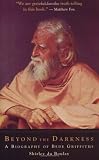
Beyond the Darkness: A Biography of Bede Griffiths
Product Description
Considered by many to be one of the great religious figures of the twentieth century and at the forefront of East-West dialogue, Bede Griffiths will gain even more recognition with this definitive biography.
Amazon.com Review
To hear about a Catholic monk who meditates and seeks nondual union with Christ doesnt seem so astonishing anymore. Thats because Bede Griffiths began blazing a trail to the East as far back as 1955. You might call Bede the Thomas Merton of England, except that Bede delved further into Eastern spirituality than Merton ever dreamed of doing. In Beyond the Darkness, Shirley Du Boulay traces Bedes ascetic tendencies back to early experiments in communal living after graduating from Oxford. A staunch atheist, Bede, like his professor and friend C.S. Lewis, then rediscovered the spiritual profundity of the Christian tradition. After entering the monkhood, a certain unarticulated pantheism led Bede to pursue the wide-open spiritual landscapes of the East, and to "discover the other half of my soul." In the 1950s, when the rest of the West turned to science and materialism for salvation, he donned the saffron robes of a Hindu monk and started a Catholic ashram in southern India. Left to his own devices by Rome, Bede, through his implacable kindness and theological writings, drew an increasingly large following, right through 1992 when he was drawing thousands of people to talks all over the world. Beyond the Darkness reveals a man who was called a saint while he lived but who achieved that status only through sustained curiosity and sincerity in his search for the truth behind all religions. --Brian Bruya
Rate Points :4.5
Binding :Paperback
Label :O Books
Manufacturer :O Books
ProductGroup :Book
Studio :O Books
Publisher :O Books
EAN :9781903816165
Price :$17.95USD
Lowest Price :$9.50USD
Customer ReviewsOm and Amen
Rating Point :5 Helpful Point :11
Shirley du Boulay has given us a beautifully crafted biography of one of the most interesting Christians of our time. In many ways, Bede anticipated and served as a center of gravity for the new winds that blew through Christianity in the last third of the twentieth century. He advocated a decentralized, collegiate authority in the Roman Catholic church, and worried about doctrinal intolerance and insularity. Most importantly, he recognized that the worlds faith traditions can indeed enter into a conversation with one another in which each enriches the other. By the end of his life, after having spent 30 odd years in Christian ashrams in India, hed become a proponent of nondualism or advaita, accepting a radical panentheism that tried to honor the both/and of intuition as opposed to the either/or of rationality.
Du Boulays biography discusses Bedes personal life, but wonderfully summarizes the successive stages of his journey toward God. Ordinarily biographies are best read only after some familiarity with their subjects writings. But this one is an excellent introduction to the thought of Bede.
Bede Griffiths was a luminary in the interfaith dialogue, and during his lifetime he helped many Christians to come to a new appreciation of the contemplative roots of their own faith by inviting them to explore the spiritualities of Hinduism, Buddhism, and Islam. Unfortunately, the interest in interfaith dialogue and exchange that he encouraged seems to have waned in recent years, and particularly after 9/11.
Rating Point :5 Helpful Point :3
I loved reading Beyond the Darkness. I always feel that I should read and know about the spiritual writers and teacher I admire and have been influential. But I must confess to hardly ever being able to finish the majority of biographies and autobiographies I have bought over the years. However, Shirley du Bouleys account of Bede Griffiths, his life, teachings, influences and ideas is an exception and made it onto a short list of those that I could not put down until I had finished.
Just by looking at Shirley du Bouleys notes, one can see that she has done her research, drawing not just from the main published works of the great man, but from many unpublished sources. Additionally, her knowledge of Christian, Hindu and Yogic spirituality shows great depth and understanding - many lesser knowledgeable writers might not have been able to tackle all these traditions together so well and in such a fluid style.
What I also loved about Beyond the Darkness, is that it is no rose-tinted overview of Bedes life, and is not afraid to shows him as being only too human at times, with problems and difficulties just like the rest of us, which for me, made him come to life much more and be someone to personally relate to.
Bede Griffiths was for many people one of the great spiritual men of the last century. His own autobiography was a best seller. But, for me, Beyond the Darkness is more insightful, as it continues where he left off - his journey to, and inclusive and interfaith experiments in, India - and takes us deeper into the mature years of his spiritual growth and the final revelation he had of the Divine Mother.
A well-balanced and insightful biography
Rating Point :5 Helpful Point :24
Father Bede Griffiths (1906-1993) was an English Benedictine monk who resided in India for nearly four decades. Ms. du Boulays book is the first major biography written about him since his death, and I, for one, bought it as soon as I could. Her meticulous, though not overwhelming, attention to the many facets of his life provides a fascinating and incredibly balanced perspective of this man of many roles: monk, mystic, writer, lecturer, and leader in Hindu-Christian interreligious dialogue. For all that I admired his embracing warmth and sheer wisdom, it helped to know just how much he had to live through i.e. she does not shy away from describing with excruciating clarity some of the vicious verbal and written attacks from both Hindu and Christian fundamentalists he endured. My hope is that this very well crafted biography brings the importance of Father Bedes vision and life into the consciousness of many seekers. Highly recommended (along, of course, with his own writings--most of which remain in print).
C. S. Lewiss pupil -- into the darkness?
Rating Point :4 Helpful Point :12
Admirers of C. S. Lewis often like to read about his life and to become vicariously acquainted with his friends, too. If you want to know about Lewis as Griffiths friend, read Griffiths own autobiography (The Golden String), his contribution to C. S. Lewis at the Breakfast Table, and The Letters of C. S. Lewis. (It is much to be hoped that all of their correspondence that survives will be published.)
However, admirers of Lewis may be advised that these two men profoundly diverged in their religious thinking. While Lewis was an apologist for orthodox Christianity, Griffiths eventually said he could understand Christ only by means of the Vedanta that Jesus rejected the God of the Old Testament that only a bit of St. Johns Gospel attained to the insight of Hindu "advaitic" mysticism, etc. For readers whose faith is close to that of Lewis -- who said he was as dualistic as possible within Christian theology, meaning preoccupied with good and evil, and aware of Gods warfare with the devil -- this book might have been better titled "Into the Darkness" of spiritual error. The book is readable and informative, presented by a biographer who wishes to promote Griffiths "deep ecumenism."
Rating Point :4 Helpful Point :10
While vastly inferior to Bedes own writings about his life ("The Golden String" especially), this book gives a great account of Bedes development from his formative years at Eastington, where he engaged in a Waldenesque experiment in "simple living" (which left a lasting mark upon him) to his nearly forty years in his ashram in India. Bede shows himself to be a genuinely ecumenical man, taking a wealth of ideas and concepts from all religious traditions that he comes into conduct with (but especially the Hindoo faiths). A man years ahead of his time, he would most probably had been excommunicated if many of his ideas had received more attention in the Roman church. He was in favour of radical reform of the Catholic Church, which he had began to think was outdated and did not speak to people in the way that it once did -- and that if it did not change its approach to speak to people in this modern day, that it would eventaully cease to be of relevance altogether. He was in favour of a married clergy and denied that the pope should be the head of the whole church, but that this was a corruption of the original church which had the pope of Rome as merely the "first among equals" -- a position that he was supposed to share equally with various other bishops throughout Christendom. His theology tended to be on the mystical side, which, to me, makes much more sense than the Biblical literalism that is sweeping the world today. He was also of the opinion that Jesus message was at odds with the Old Testament, but that it agreed in all its essentials with the teachings of the Gita. His embracing of the similarities of Christianity and Hinduism was particularly impressive, especially in this day of finger-waggling evangelistic denominationalists who assure us that only they can be right. Bede always kept an open mind and was a seeker until the very end. He never stopped growing and learning -- something that would have been impossible if he had closed his mind to any other opinions other than his own. He is an example of a very, very rare type of individual. A wonderful look at an amazing human being.
 Drawing from his autobiographical works and many other books, this volume presents the ideal entry to the cosmic and mystical spirituality of a great spiritual guide.
 Bede Griffiths, an English Benedictine monk, devoted his life to relating the two great religious traditions of Christianity and Hinduism. In developing his theology of a Christian Vedanta--a collaboration of science, mysticism, and faith--he created
0 ความคิดเห็น:
แสดงความคิดเห็น